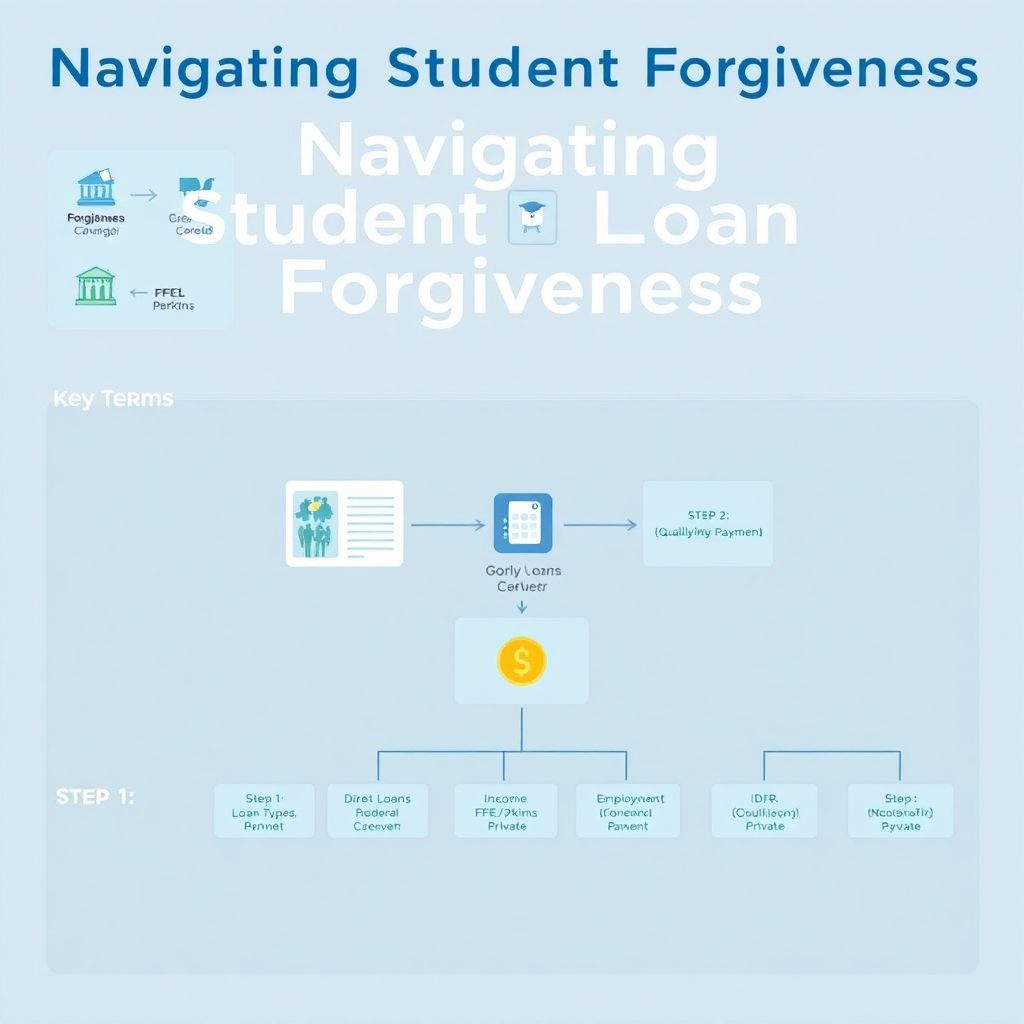
Overview: What “Navigating Forgiveness” Really Means
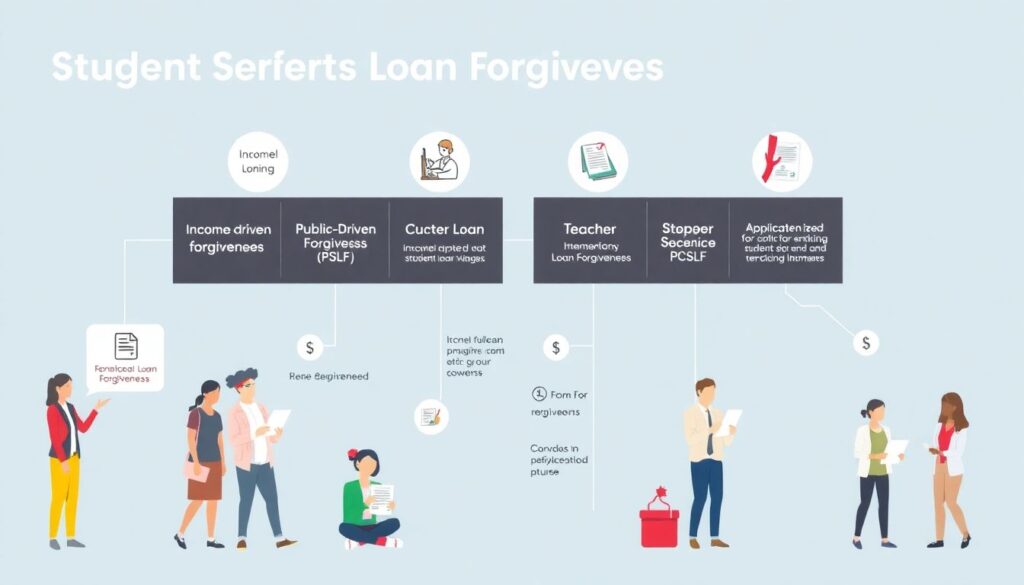
When people talk about “student loan forgiveness,” they often mix together several different concepts. From a technical standpoint, you’re dealing with a few distinct mechanisms that each have their own rules, eligibility criteria, and processing flows.
At a high level, navigating student loan forgiveness means:
– Identifying which federal or private loan types you have
– Mapping those loans to eligible forgiveness pathways
– Configuring your repayment plan and employment status to match the rules
– Executing a multi‑year compliance routine (forms, certifications, documentation)
As policy evolves and new student loan forgiveness programs 2025 proposals and adjustments roll out, the core skill isn’t memorizing today’s acronyms. It’s knowing how to read program rules, verify your data with your servicer, and avoid simple but costly configuration errors.
—
Key Terms: Speaking the Same Language
Before you choose any pathway, it helps to use the same vocabulary that loan servicers and the Department of Education use. Here are the most important technical terms, in plain English.
– Forgiveness – Your loan is canceled after you meet specific long‑term conditions (for example, 120 qualifying payments while in public service). You usually must be in a designated repayment plan.
– Discharge – Your loan is wiped out because of a qualifying event, such as school closure, identity theft, total and permanent disability, or borrower defense to repayment.
– Cancellation – Often used for program‑specific cases (e.g., certain teacher or Perkins Loan benefits). Functionally similar to forgiveness but based on role and service.
– Direct Loans – The modern federal loan type that is eligible for almost all major forgiveness programs (PSLF, most IDR plans).
– FFEL / Perkins – Older federal loan types. These often need to be consolidated into a Direct Consolidation Loan before they can qualify for newer programs.
– Income-Driven Repayment (IDR) – A family of repayment plans (like SAVE, PAYE, IBR, ICR) that tie your monthly payment to your income and offer eventual forgiveness after a set number of years.
– Qualifying Payment – A payment that counts toward a forgiveness total because it meets all rule conditions: correct loan type, correct repayment plan, correct employment (if required), and paid on time.
Think of these terms as configuration parameters in a system; the system only “credits” progress toward forgiveness when all parameters are in an acceptable state at the same time.
—
System Diagram: How Forgiveness Decisions Flow
Here’s a text-based diagram of how decisions typically branch when navigating forgiveness:
– Step 1: Identify loan types
→ Direct Loans only?
→ Mix of Direct + FFEL/Perkins?
→ Private loans involved?
– Step 2: Identify your employment profile
→ Government or qualifying 501(c)(3) nonprofit?
→ Teacher in low‑income school?
→ Private-sector employee?
– Step 3: Match to primary path
→ Public service → PSLF architecture
→ No public service → IDR-based forgiveness
→ Specific cases → Teacher, disability, closed school
– Step 4: Configure repayment
→ Enroll in eligible IDR or other required plan
→ Verify employer and loan type eligibility
→ Start logging qualifying payments
– Step 5: Monitor and verify
→ Annual recertification of income
→ Employer certification forms
→ Periodic account audits with servicer
You can think of this as a decision tree that narrows from “All borrowers” down to “Borrowers who are configured correctly for a particular program.”
—
Major Federal Forgiveness Pathways
Public Service Loan Forgiveness (PSLF)
PSLF is designed for borrowers working in public service. Technically, it’s a 120‑payment, employment‑linked forgiveness program applied to Direct Loans.
Core PSLF rules:
– You must have Direct Loans (consolidate FFEL/Perkins if needed).
– You must work full time for a qualifying employer:
– Government (federal, state, local, tribal)
– 501(c)(3) nonprofits
– Certain other nonprofit types that focus on qualifying public services
– You must make 120 qualifying monthly payments:
– Under an eligible repayment plan, usually an IDR plan
– While working for a qualifying employer
– On time and for the full amount due
If you’re wondering how to qualify for public service loan forgiveness in practice, it usually looks like this workflow:
1. Confirm your employer’s eligibility using the official online PSLF employer search.
2. Consolidate non‑Direct federal loans into a Direct Consolidation Loan if needed.
3. Enroll in an IDR plan so your payments count as qualifying.
4. Submit an Employment Certification Form (ECF) every 6–12 months and whenever you change jobs.
5. Track the official count of qualifying payments on your servicer’s PSLF tracker and dispute errors early.
Case snapshot – Maya, city hospital nurse
– Loan type: $78,000 in Direct Loans
– Employer: City‑owned public hospital (qualifying government employer)
– Steps taken:
– Switched from a standard plan to an IDR plan.
– Filed ECF annually; corrected an error where HR coded her as part‑time despite working 36 hours (hospital’s definition of full time).
– Outcome:
– After 10+ years, 120 payments posted.
– Full remaining balance discharged; she owed $0 in federal tax on the forgiven amount under current PSLF rules.
—
Income-Driven Repayment (IDR) Forgiveness
IDR plans provide a time-based forgiveness benefit that does *not* require public service, only sustained participation in a qualifying repayment plan and consistent income recertifications.
Key technical aspects:
– Monthly payment = formula based on discretionary income and family size.
– Forgiveness trigger = after a set number of years (often 20 or 25 years, depending on program and degree level).
– You must remain in a qualifying IDR plan and keep your income documentation current.
Where many borrowers go wrong:
– Failing to recertify income on time → auto‑reversion to a non‑IDR plan → months stop counting.
– Consolidating loans mid‑stream without understanding that your payment count can reset (unless covered by a special one‑time adjustment or rule change).
– Assuming all IDR plans treat graduate and undergraduate loans identically; some plans have different forgiveness clocks for each.
If you don’t qualify for PSLF, IDR is usually one of the best student loan forgiveness options for federal loans because it combines payment reduction with eventual cancellation, although tax treatment of forgiven amounts may differ from PSLF.
—
Targeted and Career-Specific Programs
Beyond PSLF and IDR, some borrowers can leverage specialized tools:
– Teacher Loan Forgiveness (TLF)
For highly qualified teachers in low‑income schools, up to a set dollar amount may be canceled after 5 consecutive years of service. Key details:
– Only certain loans qualify.
– “Highly qualified” is defined by specific credential and exam requirements.
– This program can sometimes be combined with PSLF if sequenced carefully, but the overlap rules are technical and need close reading.
– Perkins Loan Cancellation
Legacy program for older Perkins Loans; offers partial cancellation over several years of designated service (teaching, law enforcement, nursing, etc.). Each year of service cancels a percentage of the remaining balance.
– Closed School and Borrower Defense Discharges
If your school closed while you were enrolled or shortly after you withdrew, or if you were seriously misled by your institution, you may qualify for full discharge. The legal and evidentiary standards are higher here, and timelines matter.
—
Step-by-Step: How to Actually Navigate the System
This section focuses on process control—what you should do in what order to avoid getting lost.
Step 1: Inventory Your Loans
Pull your data directly from the Federal Student Aid (FSA) website:
– Verify:
– Loan types (Direct, FFEL, Perkins)
– Current servicer
– Borrowed amounts vs. current balances
– Identify:
– Which loans are federal
– Any private loans that are completely ineligible for federal programs
You cannot design a forgiveness strategy until you know exactly what objects (loans) you’re working with.
—
Step 2: Map Yourself to an Eligibility Profile
Ask yourself:
– Employment: Public, nonprofit, or private sector?
– Career plans: Will you realistically remain in public service for at least 10 years?
– Income trajectory: Rising fast, staying modest, or uncertain?
– Risk tolerance: Are you willing to bet on long-term legislative stability, or do you prefer faster payoff?
For many borrowers:
– Public or nonprofit career → PSLF + IDR.
– Private sector but moderate income → pure IDR path.
– Teachers, nurses, or other public-facing roles → consider both career-specific programs and PSLF/IDR.
—
Step 3: Configure Repayment and Documentation
Once you know your path, configure the system around you:
– Enroll in the correct repayment plan via your servicer (often an IDR plan).
– Consolidate older loans where technically necessary to make them eligible.
– Set calendar reminders to:
– Recertify income annually
– Submit PSLF Employment Certification Forms
– Download and archive monthly or quarterly account histories
Some borrowers find that using student loan forgiveness application help from nonprofit credit counseling agencies improves their chances of submitting complete, accurate paperwork the first time.
—
Step 4: Monitor, Audit, and Escalate
Because servicers change and errors happen, you need a monitoring routine:
– Every 6–12 months:
– Log in to your servicer account
– Capture screenshots or PDFs of qualifying payment counts and balances
– Check that your repayment plan and employment data didn’t change unexpectedly
– If something looks wrong:
– Contact your servicer in writing (secure message or letter).
– Keep a log of dates, names, and conversation summaries.
– Escalate to the FSA Ombudsman or Consumer Financial Protection Bureau (CFPB) if you hit a wall.
Think of this as maintaining a detailed change log in a mission‑critical system; if you ever need to dispute counts, your historical records become evidence.
—
Real-World Case Studies: What This Looks Like in Practice
Case 1: Daniel, Public Defender with Mixed Loans
– Profile: Public defender, started in 2013; mix of Direct and FFEL loans.
– Initial problem:
– Daniel assumed that as long as he worked in public service and made payments, he was “doing PSLF.”
– Only after 7 years did he learn his FFEL loans didn’t count; they weren’t Direct Loans.
– Fix:
– In 2021, he consolidated all federal loans into a Direct Consolidation Loan.
– Enrolled in an IDR plan, backdated income documents, and submitted PSLF Employment Certification Forms for each employer since 2013.
– Result:
– Due to a temporary one‑time payment adjustment (policy at the time), many of his prior payments were counted toward PSLF.
– In 2023, he crossed 120 qualifying payments and had his remaining balance forgiven.
– Lesson:
– Loan *type* is a critical technical parameter. Misconfiguring it can cost you years of progress unless temporary relief programs or adjustments intervene.
—
Case 2: Jasmine, Private-Sector Analyst Going the IDR Route
– Profile: Business analyst in the private sector, $92,000 in graduate Direct Loans, salary starting at $55,000 and gradually rising.
– Strategy:
– Jasmine never expected to work in public service, so she focused on IDR-only forgiveness.
– She chose an IDR plan that capped her payment at a percentage of discretionary income and provided forgiveness after 20–25 years.
– Challenges:
– When her income spiked due to a promotion and bonus, she considered leaving IDR to pay off loans faster.
– Her financial planner ran scenarios:
– Staying in IDR and investing the difference in retirement accounts
– Aggressively paying off the loans in 7 years
– Outcome:
– She decided on a hybrid: remained in IDR but made voluntary extra payments in years with large bonuses.
– She retained the option of long‑term forgiveness if her income ever dropped, while still accelerating payoff.
– Lesson:
– Even when forgiveness is a distant event, IDR can function as an insurance policy against volatility, not just as a path to cancellation.
—
Case 3: Luis, Teacher Leveraging Multiple Programs
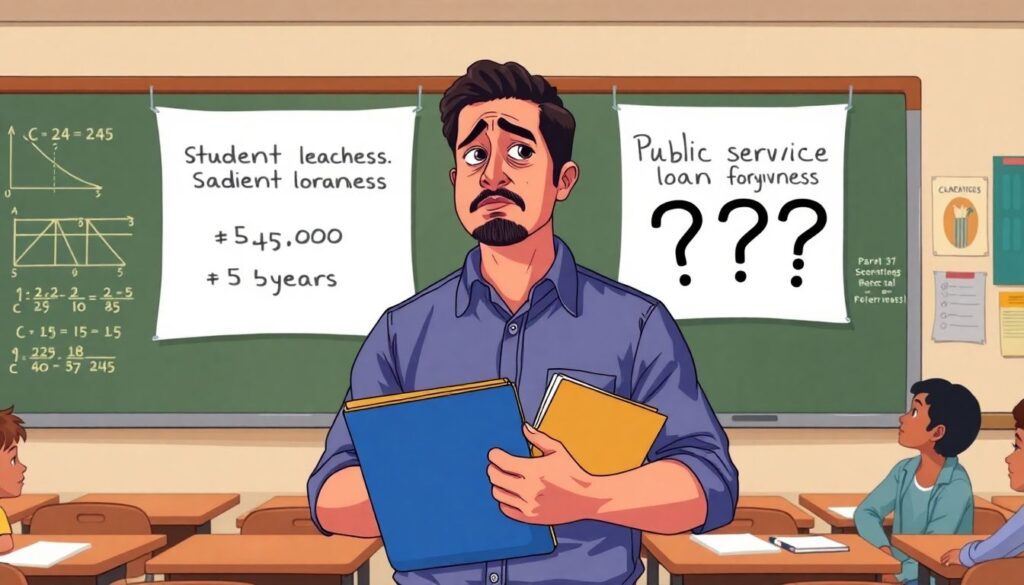
– Profile: High school math teacher in a Title I school, $45,000 in undergraduate Direct Loans.
– Approach:
– Luis qualified for Teacher Loan Forgiveness after 5 consecutive years.
– He also wanted PSLF, but the interaction between the two programs was confusing.
– Execution:
– Year 1–5: Stayed in an eligible repayment plan and documented his teaching service for Teacher Loan Forgiveness.
– After year 5: Applied for Teacher Loan Forgiveness, reducing his principal.
– Continued working at the same school and enrolled in a qualifying IDR plan.
– Submitted PSLF Employment Certification Forms from year 1 onward.
– Outcome:
– He received Teacher Loan Forgiveness first, then continued accumulating PSLF-qualifying payments.
– Eventually combined both benefits to eliminate his remaining balance sooner than PSLF alone would have done.
– Lesson:
– Multiple programs can be sequenced if you read the fine print and verify which years count for what.
—
Comparing Federal Forgiveness to Other Options
Navigating student loans isn’t just about federal programs; you should also benchmark them against other strategies.
Federal forgiveness advantages:
– Statutory and regulatory framework backed by federal law
– Options like PSLF that offer tax‑free forgiveness (under current rules)
– IDR plans that provide a safety net if your income falls
Limitations and trade‑offs:
– Long timelines (10+ years for PSLF, 20–25 for some IDR plans)
– Policy risk (future changes can modify program details)
– Administrative complexity and potential for servicer error
Private refinancing considerations:
– Can reduce interest rates, especially for high earners with strong credit.
– But once you refinance a federal loan into a private loan, it typically becomes permanently ineligible for federal forgiveness, IDR, and most forbearance protections.
Because of these dependencies, the best student loan forgiveness options for federal loans almost always involve exhausting federal tools first, then deciding if any remaining balance should be refinanced privately under carefully modeled scenarios.
Some borrowers consider whether to hire student loan consultant for loan forgiveness strategy design. Independent consultants or financial planners can help interpret regulations and optimize tax and cash‑flow outcomes, but you should:
– Verify their credentials and fee structure.
– Avoid anyone promising “guaranteed” forgiveness or asking for upfront fees to access free federal forms.
– Start with free resources from FSA, nonprofit credit counselors, or legal aid, then escalate to paid advice only if your situation is particularly complex (e.g., multi‑state employment history, mixed loan types, or pending litigation).
—
Practical Checklist for Borrowers
Use this as a condensed control list as you navigate student loan forgiveness programs:
– Loan Analysis
– Download your full loan list from the FSA website.
– Separate federal vs. private loans.
– Flag any FFEL/Perkins loans that might need consolidation.
– Path Selection
– Decide if PSLF, IDR-only, or a career-specific program (teacher, nurse, etc.) fits your profile.
– Check employer eligibility if you’re pursuing PSLF or similar programs.
– Configuration
– Enroll in an appropriate income-driven repayment plan where required.
– Submit any necessary consolidation requests with an understanding of how they affect payment counts.
– Set annual calendar reminders for income recertification and employment certification.
– Monitoring
– Log into your servicer account at least twice a year and archive statements.
– Track qualifying payment counts and challenge discrepancies early.
– Keep physical or digital copies of all forms and confirmations.
Handled this way, navigating student loan forgiveness programs 2025 and beyond becomes less about guesswork and more about running a structured, auditable process that steadily moves you toward cancellation, rather than hoping your loans “just disappear someday.”