
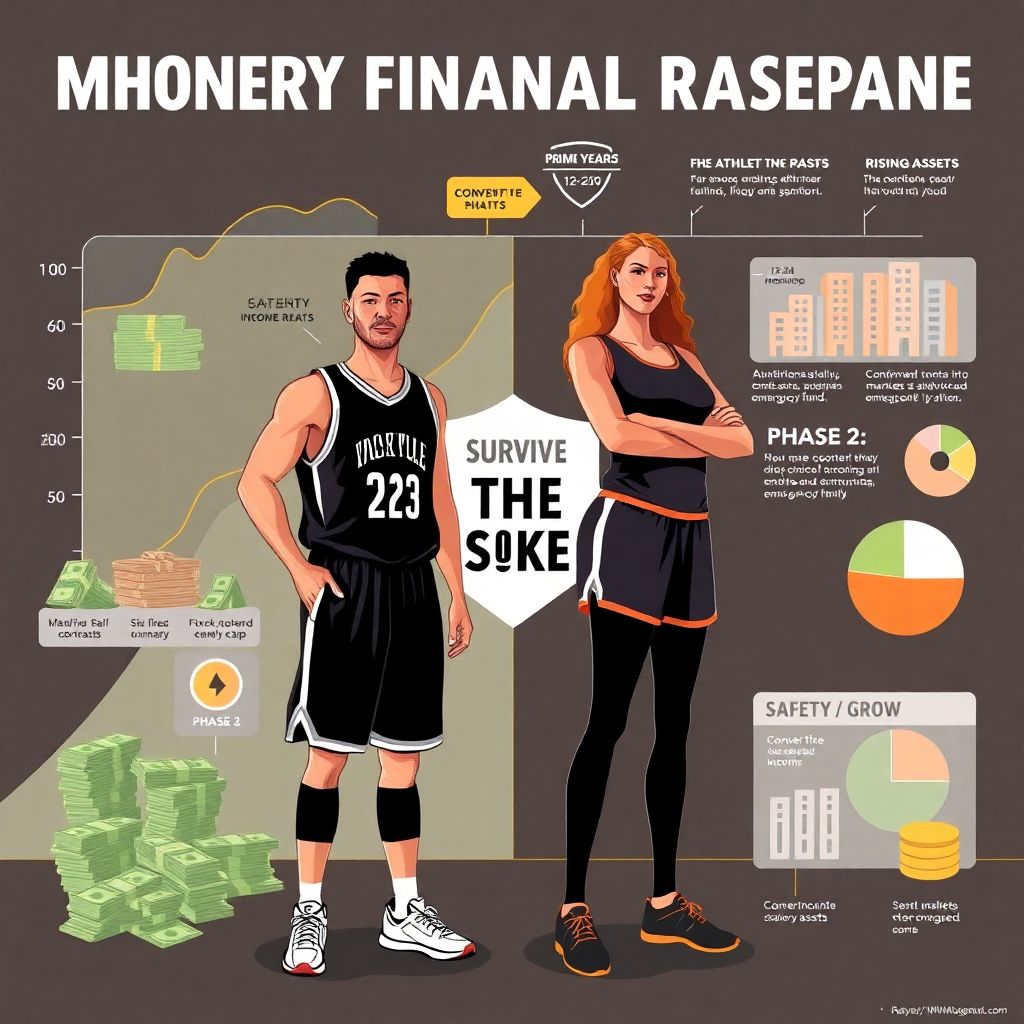
The new reality of money in sports
Professional sports money looks limitless from the outside, but the data tells a tougher story. Various studies by players’ associations and financial institutions routinely show that a large share of ex‑athletes face serious money stress within five years after retirement, despite multimillion contracts. Short careers, volatile income, injuries and pressure from social circles create a financial environment that behaves more like a high‑risk startup than a stable job. That’s why a structured approach to personal finance is no longer a luxury; it’s basic risk management for anyone who gets paid to compete, whether you are on a rookie deal, a two‑way contract or your last big extension.
Understanding your financial lifecycle as an athlete
Phase 1: Entry – the “income spike” you must survive
When you sign your first contract, your income curve usually jumps vertically while your financial literacy is still catching up. Economically, this is a shock to your personal balance sheet: cash inflow increases 10–50x instantly, but fixed costs (agents, trainers, taxes, housing, family support) also rise. A practical rule is to treat that first big deal as if it might be your last; league averages hide the fact that many careers end after just a few seasons due to performance, injury or roster churn. Building a cash buffer equal to at least 12–24 months of living expenses during this stage is not a conservative move; it is basic survival insurance in a high‑variance profession.
Phase 2: Prime years – turning earnings into long‑term capital
Your prime seasons are where compounding really happens. From a cash‑flow standpoint, this is when media deals, salary cap growth and endorsement contracts can push your income to its peak. At the same time, your risk exposure grows: bigger lifestyle commitments, more dependents, and reputation risk from any misstep. The core objective in this period is capital formation: systematically converting volatile labor income into diversified financial assets that can outlive your career. Think about each new contract as fresh “fuel” that must be allocated between safety (cash and insurance), growth (investments) and lifestyle (spending you actually enjoy and can justify).
Phase 3: Transition and retirement – replacing your paycheck
Retirement in sports arrives much earlier than in the corporate world, which changes the math completely. If you leave the league at 32 and might live to 85, you are potentially facing 50+ years without team salary. That is why retirement planning for professional athletes has to start during your first multi‑year deal, not during your farewell tour. The goal is to arrive at the end of your career with enough invested capital and diversified income streams to cover your baseline lifestyle without needing another “big break.” At this stage you switch from an accumulation mindset to a distribution strategy: managing withdrawals, taxes and healthcare costs while keeping your savings from eroding under inflation.
Why traditional financial advice often fails athletes
Most mainstream financial advice is built around stable salaries, predictable promotions and a retirement age near 65. Athletes break every one of those assumptions. Your income is front‑loaded, uncertain and highly visible, which attracts both opportunities and predators. Standard budgeting apps or generic brokerage pitches usually ignore factors like short career windows, endorsement volatility, lockout risk or international tax exposure. Effective financial planning for professional athletes therefore needs to look more like managing a small family office: cash‑flow stress testing, scenario modeling for early career termination, and contract‑driven planning rather than calendar‑driven planning. When those realities are ignored, even smart players end up asset‑rich on paper but cash‑poor and overleveraged.
Building a simple but robust money system
Step 1: Segment your accounts with clear jobs
A practical way to reduce stress is to stop treating your bank balance as one giant pile of money. Instead, segment your finances into dedicated “buckets” with different risk levels and time horizons. Your operating account covers day‑to‑day expenses; a safety reserve handles emergencies and temporary income drops; an investment pool is designed for long‑term growth. Even if you earn millions, this architecture helps you avoid lifestyle creep and keeps high‑risk ventures away from the money you actually need to live. From a behavioral perspective, separation of funds reduces emotional decision‑making and makes it easier to say no, because you can truthfully state that certain money is already committed to future obligations.
- Everyday account: monthly spending, card payments, small recurring transfers.
- Safety account: 12–24 months of core expenses in cash or very liquid instruments.
- Investment account: diversified portfolio, not used for routine purchases.
Step 2: Turn big, irregular paychecks into predictable “salary”
Most athletes are paid in chunky installments: per game, bi‑weekly during the season, or via irregular bonuses and endorsements. Without structure, this pattern leads to feast‑and‑famine cycles and aggressive off‑season borrowing. A simple solution is to pay yourself a fixed “personal salary” every month from your operating account, regardless of how large a game check was. When a big payment arrives, you first route money to taxes and obligations, then top up the safety reserve, then allocate to investments, and only then adjust lifestyle spending. This effectively converts volatile income into a stable cash flow, similar to an annuity, and gives you a defensible ceiling when friends, family or business pitches come calling.
Tax, risk and protection: the unglamorous pillars
Managing tax exposure across states and countries
Professional leagues often require you to play in multiple jurisdictions in a single season, which turns your tax profile into a complex puzzle. “Jock taxes” can mean you owe income tax in every state or country where you perform, not just where you live. Poor planning can lead to under‑withholding, penalties and cash surprises years later. Working with specialists who understand cross‑border filings, image‑rights structures, and entity setups can legitimately reduce your tax drag and smooth your cash flow. You do not need to become a tax attorney, but you do need a basic map: where your income is sourced, what your marginal rates look like, and how different contract structures affect after‑tax results.
Insurance and downside protection

Your ability to perform is a high‑value but fragile asset. From a risk‑management viewpoint, disability and loss‑of‑value policies are not optional; they are hedges on your future contracts. A career‑ending injury or a draft slide can vaporize tens of millions of future earnings, and those scenarios occur more often than players like to admit. Beyond income protection, you need adequate liability coverage for properties and vehicles, and umbrella policies to guard against lawsuits and off‑field incidents. Insurance rarely feels urgent, but it is one of the few tools that can transfer catastrophic risk off your personal balance sheet at a relatively modest and predictable cost.
Investing: from hype deals to structured strategies
Filtering opportunities in the age of social media and startups
Your public profile guarantees a steady flow of deals: restaurants, clothing brands, crypto projects, gyms, tech startups. Some may be legitimate, many will not be. Before you write a check, treat each proposal like a professional investor would. Request financial statements, understand how the business actually makes money, and ask what happens in downside scenarios. Separate marketing value from economic value: getting equity does not always compensate for unsustainable risk. The hardest discipline is staying within your circle of competence. Funding your cousin’s app idea because you feel obligated is not an investment strategy; it is a gift with paperwork attached.
Constructing a core investment portfolio
Given the volatility of your primary income, the backbone of investment strategies for professional athletes should usually be boring: diversified exposure to global equities and bonds, with position sizes calibrated to your contract guarantees and risk tolerance. Index funds, high‑quality bonds and real estate with solid cash flows often do more for long‑term security than flashy private deals. Think in target allocations: a percentage to public markets, a smaller slice to alternative assets, a capped exposure to illiquid ventures. Rebalance periodically so that no single bet or asset class can sink your future. This institutional mindset may sound dull, but its purpose is simple: to ensure your money plays a safer game than your body does.
- Prioritize diversified public markets before illiquid private deals.
- Cap any single private investment to a small fraction of net worth.
- Reassess risk tolerance after major events like a new contract or injury.
Choosing and managing your advisory team
Finding fit, not just famous names

Because your financial life is unusually complex, you will likely interact with agents, accountants, lawyers and investment professionals. The market for wealth management services for athletes has grown rapidly, with banks and boutique firms building dedicated sports divisions. Yet glossy branding does not guarantee competence or integrity. You want advisors who are fiduciaries—legally obligated to put your interests first—and whose compensation is transparent and simple to understand. Ask how they are paid, who actually manages the money, and what safeguards exist against fraud or conflicts of interest. A good test is whether they can explain complex structures in plain language you can repeat back confidently.
Specialized advice for high‑profile leagues
Athletes in major U.S. leagues face unique contract rules, benefits and media pressures, which is why the best financial advisors for NFL NBA athletes tend to have deep knowledge of specific collective bargaining agreements and pension systems. They understand non‑guaranteed contracts, roster bonuses, practice‑squad dynamics and the real odds of a second deal. When interviewing candidates, ask for case studies (with names removed) of how they handled a client’s sudden cut, a big guaranteed extension or a forced early retirement. You are looking for process, not promises: clear decision frameworks, pre‑defined playbooks for contingencies, and risk limits they will not let you cross even if you push.
Long‑term security and post‑career economics
Designing a sustainable lifestyle number
One of the most practical exercises you can do is define your “enough” number: how much after‑tax annual spending actually supports the life you want after sports. Instead of starting with your current income, start with your post‑career goals: where you want to live, how often you travel, what kind of home and support system you need. From there, reverse‑engineer the capital required to generate that spending, using conservative assumptions for investment returns. This process often reveals that you either are closer to safety than you thought—or that your current burn rate is mathematically incompatible with a long, stress‑free retirement, giving you an early chance to adjust.
Structuring retirement income streams
As your playing days wind down, your objective shifts from asset accumulation to income engineering. Pensions, deferred compensation, annuities, rental income, dividends and part‑time work can be combined into a portfolio that mimics a paycheck. The art lies in coordinating timing, taxes and risk so no single source is overloaded. Thoughtful retirement planning for professional athletes also considers healthcare inflation, potential late‑life dependents and the possibility that you may want to fund charities or family ventures. A well‑built retirement plan buys you optionality: you can coach, invest, launch a business or step away entirely, knowing your baseline financial needs are already covered by design rather than hope.
Industry impact and future trends in athlete finance
From cautionary tales to standardized education
Public stories of players going broke used to be treated as individual failures; now teams, leagues and unions increasingly see them as systemic issues. As media rights expand and franchise valuations climb, the economic stakes of athlete mismanagement grow as well. Poor financial outcomes can shorten careers, damage brand value and reduce post‑career participation in the sport’s ecosystem. In response, more organizations are rolling out mandatory financial education programs, vetted advisor lists and collaborative platforms that match players with specialists. Over the next decade, expect these structures to become as standard as strength and conditioning, with data analytics used to monitor financial health indicators alongside physical performance metrics.
Forecasts: tech, regulation and global expansion
The next wave of financial infrastructure for athletes will likely be driven by technology and regulation. Digital platforms can integrate contract data, tax obligations and investment accounts into unified dashboards, turning complex financial lives into manageable snapshots. Regulators and players’ associations are also pushing for stricter standards around who can market financial products to players, which should reduce fraud but require more formal compliance. As leagues globalize and more athletes earn money across continents, demand for cross‑border planning and currency risk management will rise sharply. Those who adapt early—by building systems, teams and habits while they are still playing—will be best positioned to convert short, intense earning windows into durable, multi‑decade financial stability.