

Why budgeting for your child’s education matters more than ever
Paying for college used to be something families could improvise: a little scholarship, a part-time job, some help from parents. Today, with tuition and fees growing faster than wages, “winging it” is basically a plan to rely on debt. Budgeting for a child’s education is about turning a vague hope (“we’ll figure it out”) into a concrete funding strategy that combines 529 plans, cash-flow from income, and a few smart backup options.
Financial planners often say the same thing: you can borrow for college, but you can’t borrow for retirement. A solid education funding plan respects that principle while still giving your child real choices when it’s time to pick a school or a training path.
—
Brief history: How we got to 529 plans
Before modern college savings plans, parents had two main tools: taxable brokerage accounts and basic savings accounts or CDs. These options were simple, but they had a big drawback—every dollar of growth was typically taxed along the way. Over a decade or more, that tax drag eroded a large chunk of potential college money.
In the late 1990s, Congress created Section 529 of the Internal Revenue Code, and states gradually rolled out their own plans under this framework. The goal was straightforward: encourage families to save for education by offering tax advantages similar to retirement accounts, but with more flexibility around when the money could be used.
529 plans evolved from relatively rigid, pre-paid tuition contracts to more market-based investment accounts. The modern plans allow you to choose diversified portfolios, adjust risk levels over time, and in many cases, use the funds for a wide variety of qualified education expenses, not just four-year universities.
—
Core principles of budgeting for a child’s education
1. Start with your overall financial picture
Before diving into the best 529 college savings plans or fancy strategies, step back:
– Are you on track for retirement contributions?
– Do you have an emergency fund (usually 3–6 months of expenses)?
– Are high-interest debts under control?
Many Certified Financial Planners will refuse to prioritize college savings if these basics aren’t covered. Their reasoning: putting money into a college fund while carrying 20% credit-card debt or underfunding retirement is financially inefficient and risky.
Once those fundamentals are stable, you can treat education savings as a long-term “sub-account” in your household budget, just like retirement or housing.
—
2. Define the target: What are you actually saving for?
“College” isn’t one number. The cost can range from a local community college to an elite private university with full residential costs. To keep your plan realistic, define a range.
Many experts suggest thinking in scenarios:
– Low-cost: in-state public university, child lives at home
– Medium-cost: in-state public with housing on campus
– High-cost: private university, full residential experience
As a starting point, use a college savings plan calculator 529 tools offered by major providers (Vanguard, Fidelity, state plan websites). These calculators let you plug in your child’s age, an assumed rate of return, and projected tuition inflation to get a monthly savings target. It won’t be perfect, but it gives you a concrete number to react to instead of a vague sense of panic.
—
3. Automate the habit, then fine-tune
The most important variable is not which fund you pick—it’s how consistently you contribute. Set up an automatic transfer from your checking account to your education savings vehicle monthly or per paycheck.
Even if you can only start with $25–$100 per month, automating that payment harnesses dollar-cost averaging and takes willpower out of the equation. Then you can escalate contributions as your income grows or as other expenses (like childcare) phase out.
—
529 plans: The workhorse of college funding
What a 529 plan actually is
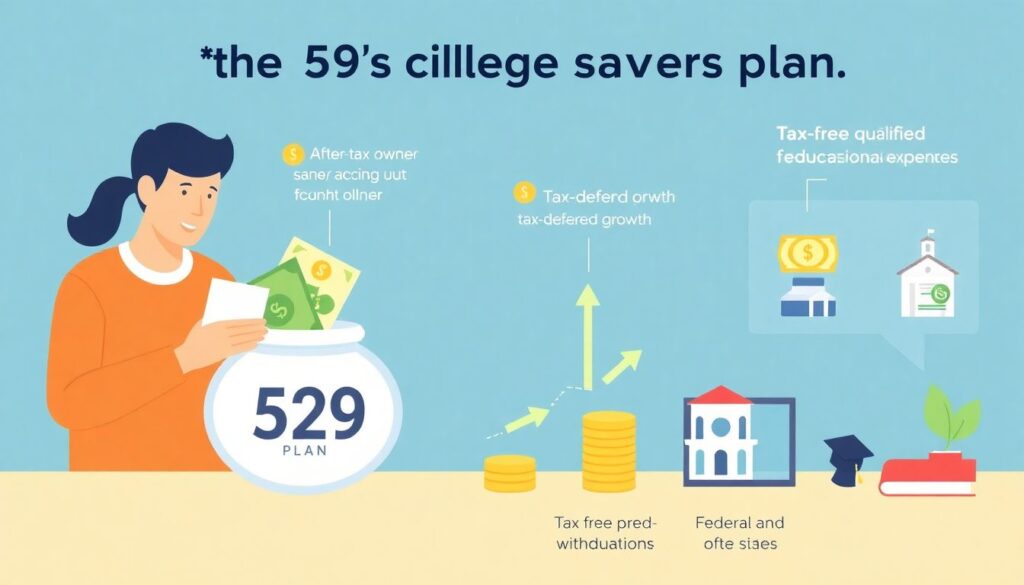
A 529 plan is a tax-advantaged investment account designed for education expenses. You (the account owner) contribute after-tax dollars, invest them, and the money grows tax-deferred. If you use it for qualified expenses, the withdrawals are generally tax-free at the federal level and often at the state level as well.
When parents ask how to start a 529 plan for my child, the practical steps are simpler than most expect:
– Choose a state plan (often your own state, but not always).
– Open the account online, listing yourself as owner and your child as beneficiary.
– Pick an investment option (more on that below).
– Set up automatic contributions from your bank.
You can open a plan in 20–30 minutes; the harder part is deciding how much to fund it over time.
—
Key advantages: Why experts like 529s
Advisors frequently highlight three major benefits:
– Tax treatment
The 529 plan tax benefits for parents are the big draw:
– Tax-deferred growth: you don’t pay taxes on dividends, interest, or capital gains annually.
– Tax-free withdrawals for qualified education costs.
– In many states, contributions are deductible or give you a state tax credit.
– High contribution limits
Unlike some other accounts, 529 plans typically allow very large aggregate contributions (often hundreds of thousands of dollars per beneficiary, plan-dependent), which is useful for long time horizons or multi-child families.
– Control stays with the parent
Your child doesn’t automatically gain control at 18 or 21. You decide when and how to spend the funds, which can prevent impulsive non-educational spending.
Because of these characteristics, professionals often put 529s at the center of an education budget, especially for families confident the child will pursue some form of post-secondary education.
—
Investment choices inside a 529
Most 529 plans offer two broad categories of options:
– Age-based or “target enrollment” portfolios that automatically shift from stocks to bonds and cash as the child approaches college age.
– Static portfolios or individual funds where you manually pick the risk level and allocation.
Many planners suggest age-based options for parents who don’t want to actively manage the portfolio. It’s a way to align risk with time horizon without repeatedly tinkering.
When evaluating the best 529 college savings plans, experts usually focus on:
– Low underlying fund expenses and plan fees
– A solid range of diversified, broad-based index options
– Reasonable age-based glide paths (not too aggressive near college)
—
529 plan vs other education savings accounts
529s aren’t the only tools in the toolbox. When thinking about 529 plan vs other education savings accounts, professionals typically compare them to:
– Coverdell ESAs: broader qualified expense list (including K–12 tuition, tutors, some educational services), but low annual contribution limits and income-based eligibility rules.
– Custodial accounts (UGMA/UTMA): not limited to education; they turn into the child’s property at the age of majority and can hurt financial aid more, plus gains are taxable along the way.
– Roth IRAs: retirement-focused, but contributions (and some earnings under conditions) can help with college. However, this can jeopardize retirement security if used heavily.
Experts often recommend a hierarchy:
1. Use a 529 as the primary education bucket.
2. Layer a Coverdell or custodial account if you want funds that can be used more flexibly or for earlier education.
3. Treat Roth IRAs as a backup lever, preserving them mainly for retirement.
—
Building education savings into a real-world family budget
Step-by-step: From intention to implementation
A pragmatic process that fee-only planners frequently use looks like this:
1. Clarify your “funding ratio”
Decide what portion of projected costs you want to cover. For example:
– 100% of in-state public tuition and fees
– 50% of total in-state cost including housing
– A fixed dollar amount (e.g., “We’ll cover $25,000 per year, the rest is scholarships/loans”)
2. Run the numbers
Use at least one college savings plan calculator 529 to translate that into a monthly or annual savings target. Stress-test by changing:
– Assumed rate of return (e.g., 5%, 6%, 7%)
– Tuition inflation estimates
– Start date and time horizon
3. Fit the target into your budget
If the “ideal” number doesn’t fit, scale back rather than abandoning the plan. Saving 40–60% of the “perfect” target is still powerful over 10–18 years.
4. Review annually
Once a year, revisit:
– Contribution level
– Asset allocation (if using static portfolios)
– Plan-level benefits (in case your state updates its incentives)
—
Example scenarios: How families actually do this
To make it concrete, here are simplified, stylized examples that mirror what advisors see in practice.
– Family A: Moderate income, one child, ages 2
They want to cover 75% of in-state tuition. Using a calculator, they estimate needing about $250/month into a 529. Right now, they can only afford $150/month. They commit to:
– $150/month automatic 529 contribution
– Increasing by $25/month every year when they get cost-of-living raises
Over time, these step-ups close much of the gap without derailing their current lifestyle.
– Family B: Higher income, two kids (5 and 8)
Their priority is flexibility. They:
– Maximize state-tax-benefit-eligible contributions to a 529 for each child
– Add a smaller monthly amount to a taxable brokerage account that can be used for gap years, graduate school, or non-education goals
This blended strategy accepts some tax drag in exchange for maximum optionality.
– Family C: Late start, teen is 15
They realize they’re far behind and can’t “catch up” fully. A planner helps them:
– Open a 529 despite the short horizon, focusing on conservative allocations
– Set realistic contribution levels for 3–4 years
– Build a cash-flow plan to redirect some of their income to tuition once child is in school
The 529 helps cover books and a portion of tuition; the main impact is reducing the amount of student debt their child needs.
—
Common misconceptions about education budgeting
“If I can’t save it all, why bother?”
One of the most damaging myths is that partial funding is pointless. Even covering one semester or one year of costs can substantially reduce your child’s need for loans and the compounding of interest over time. Advisors consistently emphasize that “some is infinitely better than none.”
—
“529 plans are too restrictive or risky”
Another misconception is that a 529 locks you into one school or one child. In reality:
– You can change the beneficiary to another family member (siblings, cousins, even yourself).
– Many plans now allow use of funds for a broad range of educational institutions, including some trade schools and foreign universities.
– Leftover funds can potentially be repurposed (subject to evolving laws—some recent changes even allow limited rollovers to Roth IRAs under specific rules).
Yes, non-qualified withdrawals can trigger taxes and penalties on earnings, but that is a manageable downside, not a financial death sentence, especially if your account has significant contributions relative to growth.
—
“Investing for college will destroy financial aid”
It’s true that assets can affect aid calculations, but the impact of a parent-owned 529 is often overestimated. In the typical needs-analysis formulas:
– Parent-owned 529 assets are usually assessed at a relatively low rate compared to student-owned assets.
– Strategic positioning (e.g., owner of the account, when distributions are taken) can mitigate aid impacts.
Most independent planners argue that being debt-averse while still optimizing for some aid is a stronger long-term position than relying almost entirely on need-based assistance that may or may not materialize.
—
Expert-backed recommendations for parents
Drawing from common themes in guidance from CFPs, college planning specialists, and tax professionals, several practical recommendations stand out.
—
1. Align education savings with your values, not just numbers
Decide what “helping with college” means in your family. Some parents aim to fully fund any school; others deliberately require their child to share costs to build responsibility. Being explicit here prevents last-minute guilt-driven decisions that may harm your own retirement security.
—
2. Use 529s as the default, but keep some flexibility
Professionals frequently treat 529s as the primary engine of the plan, especially when the child is young. At the same time, many advise keeping:
– An emergency fund strictly separate from education assets
– A modest, flexible taxable account that can support education, launching a business, or other goals if plans change
This mix prevents overconcentration in a single tax-wrapper and respects the fact that 18-year-olds don’t always follow the road you expect.
—
3. Don’t chase investments—focus on cost, diversification, and behavior

Instead of obsessing over which plan had the best performance last year, experts suggest you:
– Choose a low-cost, reputable 529 plan (even if it’s not your state’s, unless your state tax benefits are very strong).
– Opt for diversified age-based portfolios if you don’t want to rebalance manually.
– Commit to a contribution schedule and only adjust based on life changes, not market noise.
Your behavior—sticking with the plan through market swings—usually matters more than fine-tuning asset classes.
—
4. Revisit the “529 plan vs other education savings accounts” question as your situation changes
A family with a 3-year-old and a family with a 16-year-old face very different constraints. Over time, it may be appropriate to:
– Add or phase out Coverdell accounts
– Start gifting strategies from grandparents directly into 529s
– Shift marginal dollars from 529 contributions toward paying down your own debts as college approaches
Advisors stress that a good plan evolves; it’s not a one-time static decision.
—
5. Communicate with your child early and clearly
From a non-technical but very practical standpoint, experts repeatedly point to communication. Let your child know, in age-appropriate terms:
– What you’re likely to contribute
– How much they may need to cover via work, scholarships, or reasonable loans
– Why you’re structuring things this way
This sets realistic expectations and encourages your child to treat education as a joint project, not an open-ended entitlement.
—
Bringing it all together
Budgeting for a child’s education isn’t about predicting the exact tuition bill 15 years from now. It’s about putting a framework in place: protect your own financial foundation, set a realistic target, use 529 plans intelligently, and supplement them with other accounts where they make sense.
If you start early, automate contributions, and adjust as your family and the law evolve, you don’t need a perfect plan—you need a durable one. That combination of structure and flexibility is what professionals rely on themselves, and it’s what can turn today’s small monthly transfers into tomorrow’s meaningful college choices for your child.