
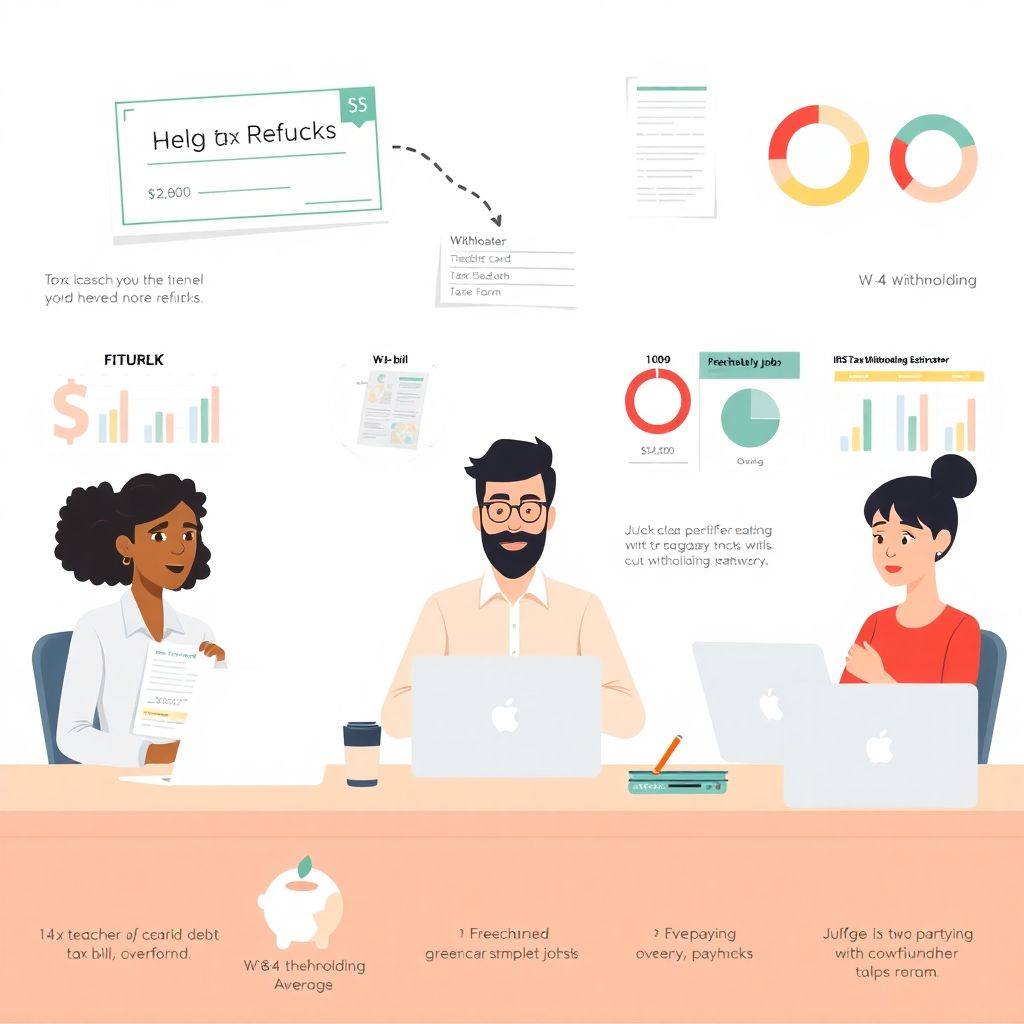
Why Your Paycheck Keeps Surprising You
If your tax refund feels like a lottery win one year and a rude bill the next, the culprit is usually your tax withholding and that mysterious W‑4 you signed… once… on your first day of work.
Over the past three filing seasons, this confusion hasn’t gone away:
– IRS data show that around 73–76% of individual tax returns from 2021–2023 resulted in a refund.
– The average refund was roughly:
– About $2,800 for the 2021 filing season
– About $3,175 for the 2022 filing season
– About $2,800–2,900 for the 2023 filing season (IRS reported $2,878 by mid‑April 2023)
So most people are consistently overpaying the IRS during the year and then getting a big chunk back. That’s an interest‑free loan to the government.
And on the flip side, roughly one out of every five taxpayers ends up *owing* in April. In other words, millions of people are guessing wrong on the W‑4.
Let’s unpack how to stop guessing.
—
The W‑4: What It Actually Does (And What It Doesn’t)
The W‑4 is not a “tax form” in the sense of filing a return. It’s a set of instructions you give your employer: *“Here’s how much federal income tax to take from each paycheck.”*
It does not:
– Change your tax brackets
– Add or remove tax credits
– Decide whether you owe self‑employment tax, capital gains, and so on
It just affects the *timing* of when you pay.
Think of it like a thermostat. The actual weather (your real tax liability) is out there regardless. The thermostat only changes when you feel the heat or cold—in your case, whether you feel the tax hit during the year or in April.
—
Real‑World Cases: Where Withholding Goes Off the Rails
Кейс 1: Большой возврат как “копилка”
Sarah is a single teacher. For three years straight:
– Her average tax refund is around $2,500–$3,000.
– She treats it as a “forced savings plan.”
– Meanwhile, she’s carrying a credit‑card balance at 20% interest.
Statistically, she’s not alone—her refunds fit right into the IRS averages above. But she’s doing something expensive: paying high interest while lending the government money for free.
Sarah finally checks an online tax withholding calculator (the IRS Tax Withholding Estimator). It shows that if she tweaks her W‑4, she can reduce her yearly refund to about $500 and add more than $200 a month to her paycheck—enough to attack her debt faster.
Same total tax paid. Completely different cash‑flow story.
—
Кейс 2: Побочка от подработки

Jason works full‑time, then picks up freelance design work on the side. His W‑2 job has “normal” withholding. The side gigs send him 1099 forms, with no tax withheld.
For a couple of years, his side income is small; his refund from the W‑2 job “covers” the extra tax. But in 2023 his freelance income jumps, and suddenly:
– He owes several thousand dollars in April.
– He also owes an underpayment penalty because he didn’t pay enough during the year.
Nothing about his salary changed—just the mix of income types. His W‑4 was never updated to reflect that, and the default withholding assumed the W‑2 job was his *only* income.
—
Кейс 3: Две работы и двойное недоразумение
Mia has two part‑time jobs. Each employer’s payroll system assumes *that job alone* is her only source of income. As a result, each job withholds at a rate appropriate for a lower income than she actually has.
Individually, both sets of paychecks look great—high net pay, low tax taken. At tax time, those two “nice” paychecks combine into one bigger income number. Her total tax jumps, and she owes a lump sum she hasn’t planned for.
This is extremely common for people juggling multiple jobs, and it’s exactly the kind of thing the current W‑4 is designed to fix—if you fill it out properly.
—
How the Modern W‑4 Works (And Why It Feels So Confusing)
The IRS redesigned the W‑4 in 2020. The old “allowances” (1, 2, 3, etc.) are gone; now you mostly:
– Tell the form if you have multiple jobs
– Estimate other income (like side gigs, interest, dividends)
– Enter deductions and credits if they’re meaningfully higher than the standard deduction
The design is actually more mathematically accurate. The problem is psychological: people were used to writing “Single, 1” and never thinking about it again. Now the form asks you to think about *your whole financial life*—and many people just skip those sections.
If you want to know how to fill out W-4 form correctly, you need to treat it like a mini tax projection, not a check‑the‑box HR form.
—
Step‑By‑Step: Adjusting Your Withholding Without Losing Your Mind
Here’s a simple framework that works for most employees:
1. Look at last year’s result.
Did you get a big refund (over, say, $1,000)? Did you owe more than you were comfortable paying? That’s your baseline error.
2. Decide your goal.
– Want a larger paycheck during the year, even if it means a small bill at tax time?
– Or do you prefer a bit of overpayment and the “comfort” of a refund?
There’s no moral right answer—just a cash‑flow decision.
3. Use a calculator, not guesswork.
Plug your information into a serious estimator. The IRS’s own tool effectively functions as a tax withholding calculator. Many private tools do this too.
4. Update the W‑4 with specifics.
Instead of random numbers, use the dollar amounts from the calculator: other income, deductions, extra per‑paycheck withholding, and so on.
5. Re‑check mid‑year.
New job? Big raise? Marriage? Baby? Side gig exploded? Re‑run the numbers and tweak. Waiting until next April is how surprises are born.
Doing this once a year—and again after big life changes—puts you ahead of most taxpayers.
—
Неочевидные решения для типичных проблем
Проблема 1: Постоянно большой возврат
Most guides say, “Just claim fewer allowances” (on the old form) or “just reduce extra withholding” (on the new one). That’s too crude.
Less obvious solution: use the W‑4 to simulate specific savings goals.
For example, if you’re used to a $3,000 refund but want to redirect that money:
– Aim for a $500 target refund instead.
– Adjust the W‑4 so your paychecks increase by about $200/month.
– Set up an automatic transfer of those $200 into a high‑yield savings account or retirement plan.
Psychologically, you still “don’t see” the money in your checking account; mathematically, it’s actually earning for *you* instead of the government.
—
Проблема 2: Нестабильный доход из‑за премий и подработок
Year‑end bonuses, commissions, or gig work can wreck standard withholding. Employers often withhold at a flat “supplemental” rate on bonuses, which may be too high or too low depending on your actual bracket.
Hidden trick: use Form W‑4 specifically to counterbalance expected spikes.
– Expect a big bonus this year? You can lower extra withholding on your regular paychecks to offset the bonus over‑withholding.
– Expect a big jump in freelance income? Add a fixed “extra” amount per paycheck on Step 4(c) to mimic quarterly estimated tax payments.
This turns your W‑2 job into a buffer that smooths out your volatile income.
—
Проблема 3: Баланс между “максимальной зарплатой” и безопасностью
People still search for “W-4 allowances for maximum paycheck,” even though the allowance boxes are gone. What they’re really asking is: *“How close to the edge can I go without getting burned in April?”*
The non‑obvious answer: you can intentionally aim for a small, controlled balance due—not zero.
Why? Because *zero* is almost never perfect. Aiming to owe, say, $200–$500 if everything goes as expected means:
– Your paychecks are a bit higher all year.
– You’re still outside the zone where penalties are likely, as long as enough tax is prepaid through withholding relative to last year and your total bill.
That’s something you can only safely do by running actual numbers in a calculator, not by randomly understating income on the W‑4.
—
Alternative Methods: W‑4 Is Not Your Only Lever
Sometimes, the most elegant solution isn’t on the W‑4 itself.
Метод 1: 401(k) и HSA как “автоматические корректировщики”
Contributions to pre‑tax retirement plans and health savings accounts reduce your taxable income. If you:
– Increase a pre‑tax 401(k) contribution
– Or max out an HSA
you can often keep the same W‑4 but end up with a lower tax bill. This is especially powerful if you’re bouncing between tax brackets; a slightly higher retirement contribution can nudge part of your income back into a lower bracket, which naturally realigns your withholding to reality.
—
Метод 2: Квартальные платежи вместо бесконечной правки W‑4
For high‑variability income (consulting, freelancing, rentals), constantly tweaking a W‑4 every time your revenue changes can be exhausting or impossible (especially if the income is entirely 1099).
Alternative: treat the W‑4 as a stable baseline and control everything else via quarterly estimated payments (Form 1040‑ES).
– Use a tax estimator mid‑year.
– Pay in a chunk each quarter for the 1099 part of your life.
– Leave the W‑2 withholding purposely a little conservative.
The combination usually hits the safe harbor rules and avoids penalties, without endless HR forms.
—
Метод 3: Цифровые сервисы и личный кабинет
You can’t literally press a button to fully change tax withholding online IRS for your employer, but you *can* use the IRS online account and the official calculators to:
– See your past tax payments and refunds
– Estimate how far off your current year might be
– Generate precise amounts to plug into a new W‑4
Many large employers also let you update your W‑4 electronically through payroll portals. So in practice, you might go from “calculator” to “electronic HR form” in minutes, with no paper at all.
—
Лайфхаки для тех, кто хочет работать “по‑взрослому”
Лайфхак 1: Использовать год в разрезе, а не как одну точку
Professionals don’t just look at “what happened last year.” They look at:
– Year‑to‑date income and withholding
– Expected income for the rest of the year
– Timing of big events (bonus in December vs. January, for instance)
Doing a mini‑projection around June or July is one of the simplest ways to avoid nasty springtime surprises.
—
Лайфхак 2: Софт вместо бумаги
Good tax pros don’t do rough napkin math anymore; they use simulators. That’s also what the best tax software to adjust W‑4 effectively does for non‑professionals:
– You enter current paystub data, expected bonuses, side income, credits.
– The software runs a forecast of your full‑year tax.
– It then tells you exactly which boxes of the W‑4 to fill and what numbers to use, often per paycheck.
This is especially useful if you have multiple states, dependents, or itemized deductions, where intuition alone is not enough.
—
Лайфхак 3: Парное планирование для семей
For married couples, one of the most common errors is treating each spouse’s W‑4 in isolation. Tax is calculated on the combined income, so:
– If both spouses claim they’re the “main” job
– Or both ignore the multiple‑jobs sections
they can dramatically under‑withhold.
Pro approach:
– Pick one spouse’s job as the “primary” income.
– Use that W‑4 to reflect the whole household: dependents, deductions, other income.
– Set the second spouse’s W‑4 more conservatively or even with extra withholding to fine‑tune.
The IRS estimator has an option exactly for “two earners” households—using it is a very underrated move.
—
What To Do Next (In One Sitting)

You don’t have to become a tax expert; you just need one focused session. A practical plan:
1. Grab your latest paystub(s) and last year’s tax return.
2. Decide your comfort zone: small refund, break‑even, or small bill.
3. Run the numbers through a reliable estimator (IRS or reputable software).
4. Print or save the recommended W‑4 entries.
5. Update your W‑4 via HR or your payroll portal.
6. Put a reminder 3–4 months from now to re‑check if anything big changes.
Do that once a year and after major life events, and you’ve already done more intentional tax planning than most people.
Your paycheck stops being a surprise. Tax season stops feeling like roulette. And the W‑4 becomes what it was meant to be all along: a simple steering wheel, not a mystery.